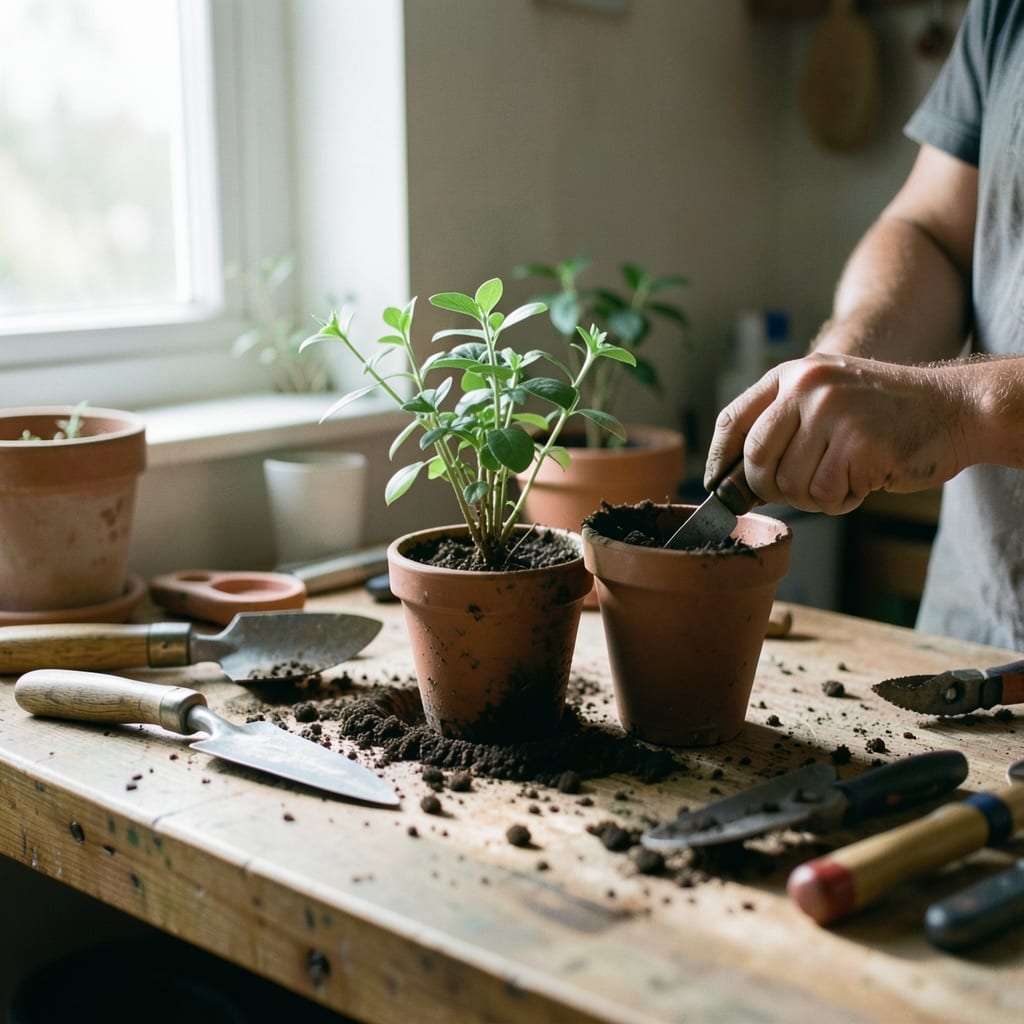
Why I started Watering Guide
I was knee-deep in a raised bed in my grandmother’s backyard, trying to coax a tray of tomato seedlings into life. The soil was too damp, the heat lamp flickered, and by the third day, every sprout had collapsed into a sad, limp pile.
The local nursery’s guidebook said nothing about the way my windowsill drafts turned the air into a sauna by noon. I called my abuela for help, and she just laughed—‘Mijo, nobody writes for *your* mess.’
So I started. Not another list of ‘best practices’ or ‘pro tips,’ but a place where the real work of gardening—the sweat, the guesswork, the quiet triumphs—gets written down like it is.
This is for the people who’ve drowned a cactus, forgotten to turn the compost pile, or watched their prized rosebush turn to mush overnight. No judgment, just answers that fit the chaos of actual yards, not the sterile rows of a catalog.
Meet the founder

The first time I held a seed packet, I was seven, stealing my mom’s basil seeds to plant in a cracked terracotta pot on my windowsill.
The pot had a chip the size of a dime—she’d told me not to use it—and by the time the first leaves appeared, the soil had baked into a crust. I watered it every morning anyway, just to watch it wilt and revive like a stubborn old friend.
That pot is still on my desk, though the basil days are long gone. The chip’s filled with caliche now, and the cracks in the glaze hold the last of the soil like it’s memorizing the shape of roots.
What I learned from my mom wasn’t in her lectures—it was in the way she’d sigh when I asked if I could ‘just try’ something, then hand me the pruners anyway. ‘You’ll ruin it,’ she’d say, and I always did.
The first time I deadheaded my mother’s prize-winning roses, I snapped off half the blooms. The second time, I got the hang of it. Now I prune with my eyes closed, and she still rolls hers when I send her photos of my ‘experiments.’
The failure that changed everything was the year I tried to grow watermelons from seed in a 5-gallon bucket. I’d read that ‘container gardening’ was easy, so I stuffed the bucket with potting mix, planted three seeds, and watered like a maniac.
By July, the vines had taken over my balcony, but the fruit? The size of a golf ball. I’d forgotten that watermelons need *space*—not just in the pot, but in the sky.
That year, I also learned that ‘drought-tolerant’ doesn’t mean ‘forget to water.’ The lesson stuck: I now measure the gap between pots and the sun before I promise a plant will thrive.
There’s one habit I can’t shake: I talk to my plants. Not in the ‘hey, little guy’ way, but like I’m explaining the weather to them. ‘Today’s the day the humidity’s gonna drop, so I’m giving you extra water *now*, before your leaves get crispy.’ My neighbor thinks I’m crazy.
My abuela just nods and hands me another seed packet. The truth is, it works. Plants respond to rhythm, and mine hear mine.
Gardening isn’t about having a green thumb—it’s about having the patience to let the soil do the work.
Arturo Gutierrez (and every plant that’s ever survived his ‘care’)
Meet the mascot

The first sketch of what would become our mascot started on a napkin at a roadside diner in New Mexico, where I’d stopped after a day of watching chiles blister under the sun.
I’d drawn a seedling poking through cracked earth, but the roots looked like a tangle of spaghetti—too busy, too much. My coffee had gone cold by the time I realized the problem: the drawing needed a *story*, not just a shape. So I simplified.
The roots became a single, stubborn line, like a stubborn gardener’s will. The leaves? Just two, sharp as the edge of a pruner.
The proper drawn version came later, on a yellow legal pad in my kitchen. I’d propped it against the windowsill so the light hit the page at the same angle as my tomato plants.
The seedling’s stem got thicker, its leaves a deeper green, and the soil turned from brown to the color of wet clay—because that’s what real dirt looks like, not the sterile mix in bags. The crack in the earth became a jagged line, like a fault line.
I named it *Raíz* (‘Root’), because it’s the part of the plant you don’t see until it’s too late to fix what’s wrong.
By the time it needed to fit on a browser tab, half of it had to go. The soil became a single stripe, the leaves reduced to a single leaf, and the crack turned into a hairline fracture.
Raíz lost its shadow, its texture, even the tiny hairs on the stem. But the stubborn line of the root stayed—because that’s the part that matters. It’s not pretty. It’s not ‘cute.’ It’s what keeps growing when you think you’ve ruined everything.
What I promise you
This site isn’t about perfection. It’s about the mess in between—the split seed, the first true leaf, the moment you realize you’ve been watering too much and the plant’s already rotting. You’ll find no ‘foolproof’ methods here, because gardening isn’t foolproof.
But you *will* find the things that work, the things that fail, and the quiet tricks that turn ‘maybe’ into ‘you did it.’
What you can hold me to
- Every ‘tip’ has a ‘but’—because context matters. If I say ‘water deeply,’ I’ll also tell you when to stop, or how to tell if you’ve drowned your plant.
- Seasonal adjustments are baked in. A March planting in Maine isn’t the same as a March planting in Miami, and I’ll call out the difference.
- No ‘wait until it looks right.’ Every step has a time, a temperature, or a visual cue—because guessing is how you kill your basil.
- If I don’t know, I’ll say so. And if someone else’s method has worked for them, I’ll link to it with a ‘YMMV’ (Your Mileage May Vary) warning.
How I create a guide
A guide starts in the dirt—or at least, in the place where the dirt *should* be. If I’m testing a new fertilizer, I’ll divide a pot of soil into thirds: one gets the store-bought mix, one gets my abuela’s secret compost tea, and the third gets nothing.
The ‘nothing’ pot is the control, the one that tells me if the fertilizer is helping or just lying. If the basil in the compost tea pot grows twice as fast, but the leaves turn yellow by week three, I’ll write that down too.
Because the goal isn’t to sell you a product; it’s to tell you what *actually* happens when you try it.
The first stage: watching
The first 72 hours with a new plant are spent with a finger on the soil and an eye on the light. I check moisture by pressing my thumb into the dirt—if it springs back, it’s dry; if it sticks, it’s soggy.
I watch for the ‘wilt point,’ that moment when the leaves go from droopy to crispy, because that’s when you know you’ve crossed from ‘recoverable’ to ‘too late.’ Temperature matters too: a seedling in a cold frame in April might need shade cloth by noon, even if the forecast says ‘sunny.’ I keep a notebook by the window, scribbling notes like ‘Day 3: 7am shade, 3pm water’ until the plant either thrives or tells me I’ve screwed up.
The second stage: fixing
If the leaves are yellowing, it’s either too much water or not enough nutrients. I’ll flush the soil with plain water first, then add a diluted fish emulsion if the problem persists. Fungal spots?
I’ll move the plant to a spot with better airflow and treat it with neem oil—*after* I’ve confirmed it’s not a pest eating the leaves from the underside. And if the soil’s compacted? A fork, not a trowel.
I learned that the hard way when my peppers refused to root because I’d packed the mix too tight. The fix? Loosen the dirt like you’re fluffing a pillow, not stabbing it.
How a page gets onto this site
A guide isn’t done when the plant survives—it’s done when I can explain *why* it survived.
I’ll rewrite a page three times before it goes live: once after the initial test, once after I’ve let someone else try the method (because my ‘perfect’ conditions aren’t yours), and once after the season changes.
The notes from those rewrites pile up on my desk like dead leaves—some get cut, some get expanded, and a few become their own guides. The only rule? If I can’t explain it in plain English, it doesn’t belong here.
Write to me
I love hearing about the plants that outsmarted you, the methods that worked when mine didn’t, and the gardening myths you’ve proven wrong. Did your tomatoes thrive in a bucket when every guide said they needed a hill? Did your neighbor’s ‘drought-proof’ succulents die the second you touched them?
Send it to me—I’ll test it, write about it, and maybe even name a guide after your disaster. You’ll find the contact page in the menu above.
And if you’re writing to argue with me about compost tea, fair warning: I *will* send you a link to a study that proves you’re wrong.
Arturo Gutierrez
The guides are grouped by category: Advice, Aphids, Blooming, Companion Plants, Container Gardens and Diseases.