
Plants
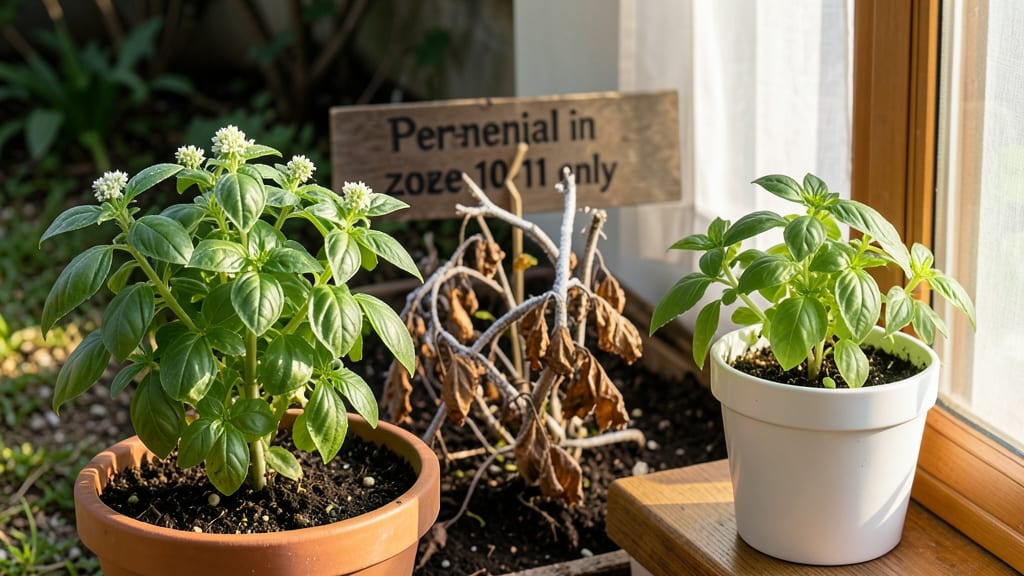
Basil plants are not perennial in cold climates—they die back when temperatures drop below 40°F, but regrow from roots if protected or replanted from seeds each spring in zones 5-10. Hardy varieties like Thai basil may survive light frosts with mulching.
Basil thrives as an annual in cold regions because its tropical origins make it sensitive to frost, unlike hardy perennials such as mint or oregano. 🌱 The roots may survive light freezes in zones 5-10 if properly insulated, but the plant itself will blacken and die back when temperatures consistently drop below 40°F.
What's fascinating is how these roots can regenerate in spring—given warmth and moisture, they'll often sprout new growth within weeks. For gardeners in colder areas, this means treating basil more like a biennial: harvest heavily in fall, then either overwinter indoors or replant fresh seeds each spring.
This dieback cycle isn't a flaw—it's actually an adaptation. Many tropical plants evolved to prioritize rapid growth during warm seasons, then conserve energy through dormant roots when conditions turn harsh.
The key difference between basil and true perennials lies in their root systems: basil's roots are more delicate and require consistent warmth to regenerate, while perennials like thyme have deep, frost-resistant root networks.
💡 In This Article
- Why Basil Dies in Winter: Temperature and Growth Cycle Science
- How to Overwinter Basil: Extending Its Life in Cold Climates
Why basil dies in winter: temperature and growth cycle science
Basil's tropical origins make it highly sensitive to cold, as its ideal growing conditions range between 70-80°F.
When temperatures dip below 40°F, the plant's cellular membranes begin to rupture due to ice crystal formation, causing irreversible damage to leaves and stems. 🌡️ This process is called "cold acclimation failure"—unlike hardy perennials, basil lacks the biological mechanisms to produce protective proteins (like antifreeze proteins) that prevent ice damage in cold-hardy plants.
The roots tell a different story: while basil's above-ground parts freeze and die, the root system can remain viable in zones 5-10 if protected by at least 4-6 inches of organic mulch.
Studies show that Thai basil varieties have slightly better cold tolerance due to their thicker cuticles and higher wax content, which helps reduce water loss during frost events. However, even these hardier types won't survive prolonged exposure to below 25°F without additional protection.
This dieback cycle differs significantly from true perennials like mint or oregano, which can regrow from their crowns even after being completely buried under snow.
Basil's roots are more shallow (typically 6-12 inches deep) and lack the energy reserves needed for extended dormancy. 🌱 For comparison, peppermint roots can survive at 10°F thanks to their deep rhizomatous system, while basil's fibrous roots simply can't store enough carbohydrates to sustain regrowth through harsh winters without intervention.
Another key factor is basil's rapid growth cycle. In warm climates, it grows aggressively to complete its life cycle within 60-90 days, prioritizing seed production over winter survival.
This evolutionary trait explains why even with proper overwintering, basil often produces smaller leaves in its second year compared to its first—its energy is focused on regrowth rather than full vigor.
What most gardeners don't realize is that basil's sensitivity extends beyond just temperature. The plant also suffers from "chilling injury" when exposed to 45-55°F for prolonged periods, even without freezing.
This causes discoloration, stunted growth, and poor flavor development—a phenomenon particularly problematic in spring when nights remain cool. 🌿 This is why many gardeners in transitional zones prefer to start fresh seeds each year rather than attempting overwintering.
Interestingly, basil's annual nature in cold climates actually works to its advantage in terms of pest resistance. Each new planting benefits from a "clean slate" free of accumulated soil-borne pathogens that might weaken perennial herbs over time.
The trade-off? You'll miss out on the gradual flavor development that occurs in true perennials like rosemary or thyme, which deepen in complexity with each growing season.