
Plants
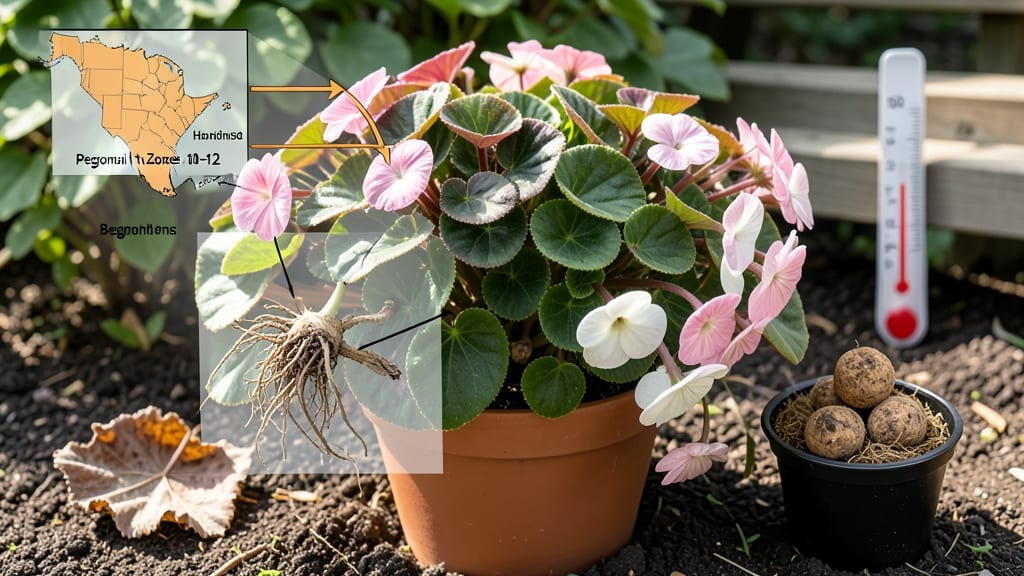
Begonias act as perennials in frost-free climates (USDA Zones 10-12) but behave like annuals in colder regions, where they'll die back completely each winter unless you take special care. Their ability to regrow depends entirely on whether their roots survive freezing temperatures.
This distinction comes down to how begonias handle temperature shifts. 🌱 In warmer zones, their roots naturally persist through the year, allowing new growth to emerge each spring. However, in colder climates where frost occurs, even tuberous varieties (like Begonia tuberhybrida) need protection to avoid irreversible damage.
The key difference between perennials and annuals here isn't just about growth cycles—it's about whether the plant's underground structures can withstand winter conditions.
For gardeners in USDA Zones 3-9, this means treating begonias like seasonal plants unless you implement overwintering strategies. Many varieties actually go dormant in cooler weather, storing energy in their roots or tubers.
The challenge lies in maintaining the right balance of moisture and temperature during dormancy to prevent rot while preserving enough energy for next year's growth.
💡 In This Article
- How Climate Zones Determine Begonia Lifespan
- Winter Care Tips to Preserve Begonias Year-Round
How climate zones determine begonia lifespan
Begonias thrive as true perennials only in frost-free environments like USDA Zones 10-12, where temperatures never dip below 20°F. In these zones, their fibrous roots or tubers remain active year-round, continuously producing new foliage.
The magic happens through a process called dormancy avoidance—their metabolic rate stays just high enough to sustain minimal growth even during cooler months, unlike true winter dormancy seen in hardy perennials like hostas.
The critical threshold is 32°F: when frost hits, begonia cells begin to rupture due to ice crystal formation in their thin, moisture-rich tissues. Tuberous varieties like Begonia x tuberhybrida store starch reserves, but these reserves can't protect against prolonged freezing.
In Zones 7-9, where winters occasionally drop below 25°F, even well-established plants will die back completely unless you provide protection. This is why gardeners in these zones often treat begonias as annuals unless they implement overwintering strategies.
What makes begonias unique is their thermoperiodic response—they detect temperature shifts through specialized proteins called CBF (C-repeat binding factors) that trigger dormancy when nights stay consistently below 50°F for 2-3 weeks.
This is why you'll see healthy begonia foliage persisting into fall in warm climates, while northern varieties shut down growth earlier as a survival mechanism. The root systems of fibrous begonias contain secondary meristems that can regenerate, but only if they're not frozen solid.
Consider this comparison: A Begonia rex in Zone 11 might grow continuously with minimal dormancy, while the same plant in Zone 8 would require 6-8 weeks of dormancy at 45-55°F with 50% humidity to survive winter.
The difference comes down to how their photosynthetic pathways adapt—warm-climate varieties maintain C3 photosynthesis year-round, while cooler-climate varieties shift to CAM photosynthesis during stress periods, conserving water and energy.
Here's what's actually happening at the cellular level: Begonias produce antifreeze proteins similar to those in winter wheat, but their production is temperature-dependent. In Zones 10-12, these proteins are sufficient to prevent ice damage, while in colder zones, the proteins aren't produced in high enough concentrations.
This biological limitation explains why even heat-loving varieties can't survive northern winters without human intervention.
The USDA zone classification system accounts for these biological realities by mapping average annual minimum temperatures. For begonias specifically, Zone 10 (30-40°F winters) represents the northern limit where they can persist outdoors year-round with 80% survival rates.
In Zone 9 (20-30°F winters), you'll need to dig up and store tubers, while Zone 8 (10-20°F winters) typically requires complete overwintering indoors. 🌡️