
Flowers
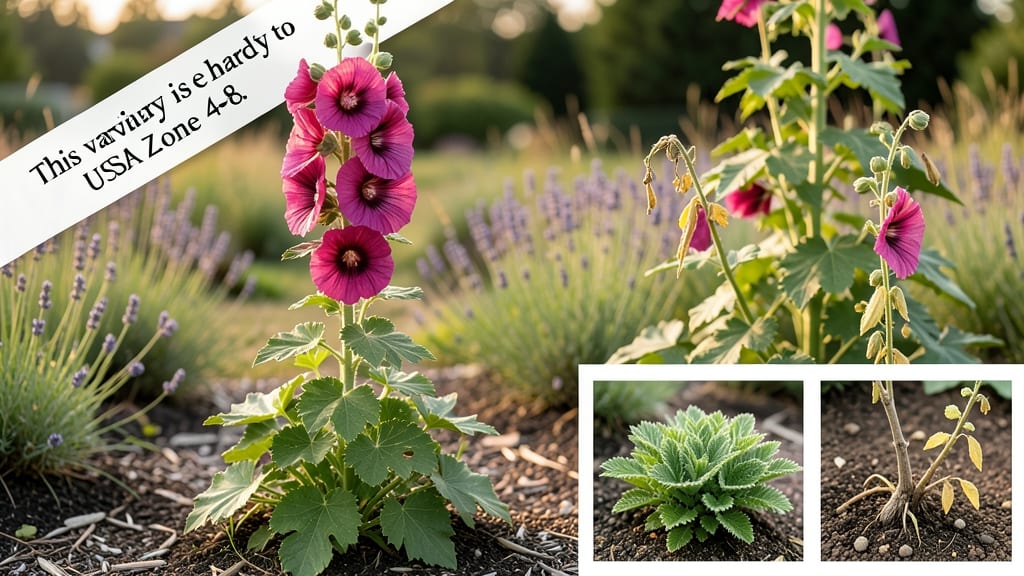
Hollyhocks are technically perennials but often treated as short-lived perennials or biennials in colder climates, dying back to the ground each winter and regrowing from their roots when conditions improve.
Hollyhocks thrive as perennials in warmer regions but face unique challenges in colder climates where their growth cycle shifts. 🌱 The key lies in their robust root systems, which store energy during dormancy—allowing them to bounce back when temperatures rise above 50°F.
In zones 3-5, they may appear dead for months, only to surprise gardeners with fresh shoots by late spring. This "dieback" behavior is why many gardeners treat them as biennials, though they can live for several years with proper care.
What sets hollyhocks apart is their resilience—even after complete foliage loss, their roots remain viable as long as they're not frozen solid. Pruning dead stems in early spring (when new growth appears) helps redirect energy to root regrowth.
The trade-off? Their shorter lifespan compared to true perennials like peonies, which makes them ideal for gardeners who enjoy seasonal transformations without long-term commitments.
💡 In This Article
- Hollyhock Cold Hardiness and Dieback Patterns
- Reviving Hollyhocks After Winter Dieback
Hollyhock cold hardiness and dieback patterns
Hollyhocks exhibit a fascinating survival strategy that blends perennial resilience with seasonal dormancy. In USDA zones 3-9, their ability to endure winter hinges on their deep, fibrous root systems which store carbohydrates and nutrients.
These roots can withstand temperatures down to -20°F in zone 3, though prolonged exposure below 10°F may cause surface dieback. The magic happens in their root crowns—thickened stem bases that act as energy reservoirs, similar to how peonies survive winter.
What makes hollyhocks appear "dead" is their complete above-ground dieback during winter dormancy. This isn't true death but a survival adaptation where all foliage and stems wither as temperatures drop below 40°F. The roots remain metabolically active, though at minimal levels, preparing for spring regrowth.
In warmer zones (7-9), they may retain some basal foliage through winter, but even here, they enter a reduced-growth state when nights dip below 50°F. 🌱 This dormancy cycle explains why gardeners often mistake them for biennials—they complete their full life cycle in just two years in colder regions.
The key temperature threshold for dormancy begins when average nighttime temperatures consistently fall below 55°F for two weeks. At this point, hollyhocks trigger a physiological shift where they halt top growth and redirect resources to root storage.
This process is controlled by plant hormones like abscisic acid, which signals cells to enter a state of suspended animation. The roots maintain a 5-10% moisture content during dormancy, just enough to prevent desiccation while remaining viable.
Zone-specific behaviors reveal their adaptability: In zone 4, hollyhocks may lose all foliage by November but show green shoots by April when soil temperatures reach 45°F. In zone 8, they might retain some winter foliage but still produce stronger spring growth after a rest period.
The trade-off for this resilience is their shorter lifespan compared to true perennials—their root systems degrade over 3-5 years without division, which is why many gardeners replant every few seasons.
What most gardeners don't realize is that hollyhocks actually benefit from winter's cold period. The freezing process breaks down complex starches in the roots into simpler sugars, which provide an energy boost when growth resumes.
This natural "cold stratification" is why hollyhocks planted in fall often outperform those planted in spring—they get a head start on their energy reserves before the growing season begins.
Consider these cold hardiness factors when selecting varieties: Single-flowered types tend to be more cold-tolerant than double-flowered cultivars, which often have weaker stems. The 'Hansa' series, for example, thrives in zone 3 with proper mulching, while 'Black Prince' may need winter protection in zone 4.
The key is choosing varieties matched to your specific microclimate—hollyhocks in sheltered locations can survive 5°F colder than those in exposed sites.