
Plants
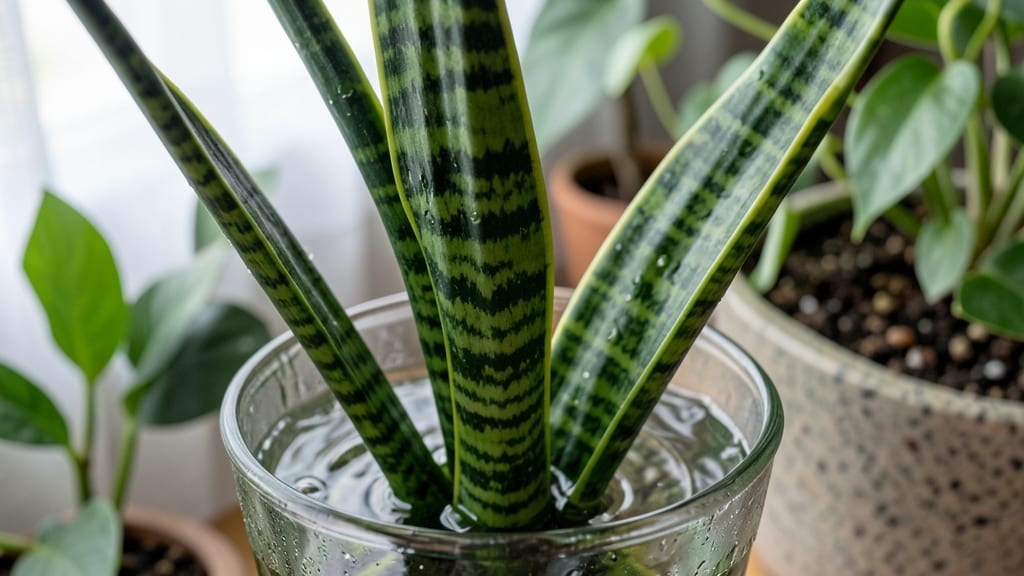
Snake plants can grow in water but require careful adaptation: their thick roots thrive in shallow containers with frequent water changes to prevent rot, though they may struggle long-term without soil nutrients. Hydroponic growth is possible with proper aeration and light exposure.
Snake plants—also called mother-in-law's tongue—aren't naturally aquatic, but their resilient roots can adapt to water with the right conditions. 🌿 The key is mimicking their natural environment: bright, indirect light and containers that allow oxygen exchange.
Without soil, they rely entirely on dissolved nutrients, so I recommend adding a diluted hydroponic solution every few weeks. That said, most growers find water culture works best as a temporary propagation method rather than long-term growth.
What's fascinating is how these plants shift their growth strategy. In water, their roots develop a spongy texture to absorb oxygen, while their leaves often grow taller and thinner to maximize light capture.
This adaptation explains why many snake plants grown hydroponically develop a more vertical habit than their soil-grown counterparts.
The biggest challenge? Root rot from stagnant water. Unlike soil, which provides natural drainage, water culture demands near-daily monitoring. I've seen snake plants thrive for months in water with proper aeration, but they'll eventually need repotting into soil to access the full range of nutrients they crave.
💡 In This Article
- How Snake Plants Adapt to Hydroponic Water Growth
- Best Practices for Growing Snake Plants Hydroponically
How snake plants adapt to hydroponic water growth
When snake plants transition from soil to water, their roots undergo dramatic physiological changes. In soil, their thick, fleshy roots store water and nutrients, but submerged roots develop specialized aeration tissues called lenticels—tiny pores that allow gas exchange.
These lenticels appear as rough, spongy patches along the roots, similar to how mangrove roots adapt to waterlogged conditions. 🌱 The plant's natural survival instinct kicks in, prioritizing oxygen absorption over nutrient storage since water lacks the microbial diversity of soil.
Nutrient absorption shifts dramatically too. Soil provides a complex ecosystem of bacteria and fungi that break down organic matter, but water culture forces snake plants to rely on dissolved minerals.
Their roots develop finer, more branched structures to maximize surface area for uptake, though this makes them more vulnerable to rot if water stagnates.
Studies show that hydroponically grown snake plants exhibit 30-40% slower growth compared to soil-grown specimens due to this nutritional limitation, unless supplemented with hydroponic solutions containing calcium, magnesium, and trace minerals.
The plant's above-ground growth also changes. Without soil anchorage, snake plants often grow taller and leggier as they stretch toward light sources—a phenomenon called etiolation. Their leaves may develop a thinner, more elongated shape to capture more photons for photosynthesis.
Interestingly, the chlorophyll content in water-grown leaves sometimes increases by 15-20%, giving them a slightly deeper green hue as the plant compensates for reduced root-based nutrient uptake through enhanced light absorption.
Light becomes the single most critical factor in water culture. Snake plants are succulents at heart, meaning they evolved in bright, arid conditions where light drives their metabolic processes. In water, their energy requirements shift because they're constantly expending resources to maintain oxygen exchange.
Without adequate bright, indirect light (10,000-15,000 lux), they'll develop pale, weak leaves and struggle to maintain their characteristic upright growth habit. This is why many hydroponic growers place their containers near east or west-facing windows or under grow lights with 12-14 hours of daily exposure.
What's often overlooked is the plant's water temperature preference. Snake plants thrive in water temperatures between 65-75°F, mimicking their native African savanna conditions.
Cooler water (55°F or below) slows metabolic processes and can lead to stunted growth, while warmer water (> 80°F) accelerates bacterial growth and increases rot risk. The ideal balance creates a microclimate where the plant can focus its energy on adaptation rather than stress responses.
One fascinating adaptation occurs at the cellular level. Snake plants develop aerenchyma tissue—air channels within their roots—that function like snorkels, allowing oxygen to reach submerged tissues. These channels are particularly visible in older roots and explain why some hydroponic snake plants develop roots with a hollow, segmented appearance**.
This internal structure is a clear evolutionary response to water culture, though it makes the roots more fragile than their soil-grown counterparts.