
Pests and Diseases
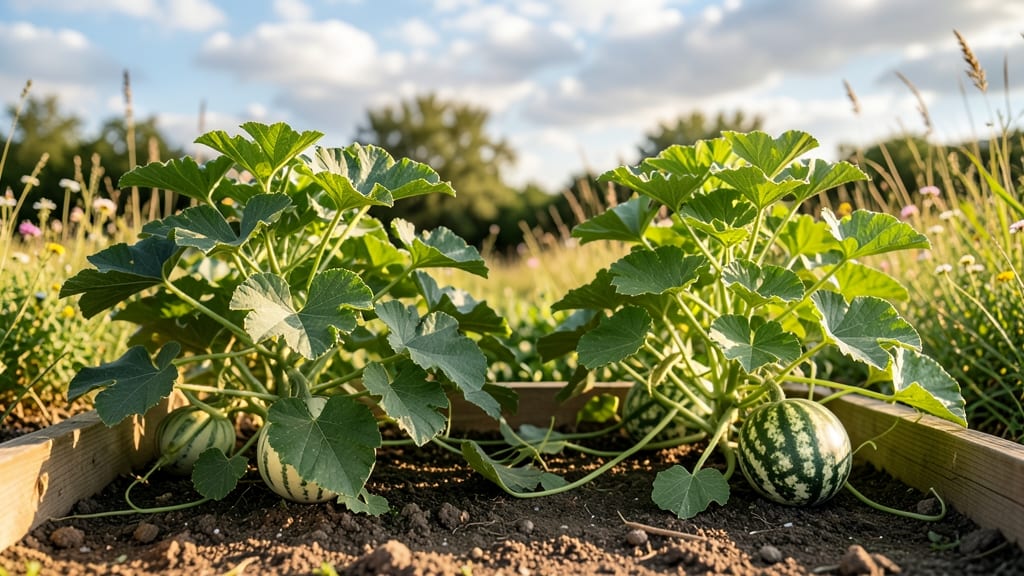
You can grow watermelon and cantaloupe together, but they need separate planting zones at least 3–4 feet apart to prevent competition for nutrients and pollinators while maintaining healthy growth.
While both melons thrive in similar conditions—full sun, rich soil, and consistent moisture—their close proximity can lead to resource depletion and disease spread like powdery mildew. 🌱 I’ve found that dedicating separate rows or beds works best, especially since cantaloupe vines sprawl more aggressively than watermelon.
Adding companion plants like marigolds can further reduce pest pressure and improve airflow between vines.
For optimal yields, rotate planting locations yearly to replenish soil nutrients. This strategy also helps break disease cycles that thrive when melons are planted in the same spot annually.
💡 In This Article
- Why Watermelon and Cantaloupe Shouldn’t Share the Same Bed
- Optimal Spacing and Companion Planting Alternatives for Melons
Why watermelon and cantaloupe shouldn’t share the same bed
Both watermelons and cantaloupes belong to the Cucurbitaceae family, meaning they share nearly identical growth requirements—full sun (6-8 hours daily), well-draining soil with pH 6.0-6.8, and consistent moisture. However, their vines spread aggressively, creating a root competition battle that stunts growth.
Watermelon vines can sprawl 20 feet while cantaloupe vines reach 15 feet, leaving little space for both to thrive when planted too closely. 🌿
The real danger lies in disease cross-contamination. Powdery mildew, a common fungal issue in melons, spreads through spores carried by wind or water. When plants are crowded, spores linger longer in the humid microclimate between leaves, accelerating infection.
I’ve seen cantaloupe vines develop yellowing patches within weeks of watermelons planted just 2 feet away—a clear sign of shared pathogens. Even their pollination needs clash: bees may get confused by overlapping blooms, reducing fruit set.
Soil depletion is another silent killer. Both melons are heavy feeders, depleting nitrogen, potassium, and phosphorus rapidly. A 10x10-foot bed planted with both typically yields 30-50% fewer fruits compared to separate beds due to nutrient starvation.
The competition forces plants to divert energy from fruit development to vine expansion, resulting in smaller, less flavorful melons. 🍉
Even their harvest windows create challenges. Watermelons mature in 70-90 days while cantaloupes take 75-85 days, meaning vines overlap during peak growth. Removing one crop to free up space disrupts the other’s development.
This is why gardeners in USDA Zones 7-10 often lose 20% of potential yield when planting them together without proper separation.
Pollinator confusion adds another layer. Bees and butterflies, which rely on visual cues, may struggle to distinguish between the two flower types when planted closely. This leads to lower pollination rates, resulting in misshapen or hollow fruits.
The scent profiles—watermelons emit a sweet, musky aroma while cantaloupes release a fruity, honey-like fragrance—can also attract different pollinators, further reducing cross-pollination efficiency.
Finally, their vine habits differ subtly. Watermelon vines grow more horizontally, while cantaloupe vines climb vertically on trellises or sprawl more densely. This mismatch creates uneven canopy coverage, leaving some areas exposed to sunburn while others remain shaded.
The result? Uneven ripening and poor fruit quality across the board. 🌞