
How To
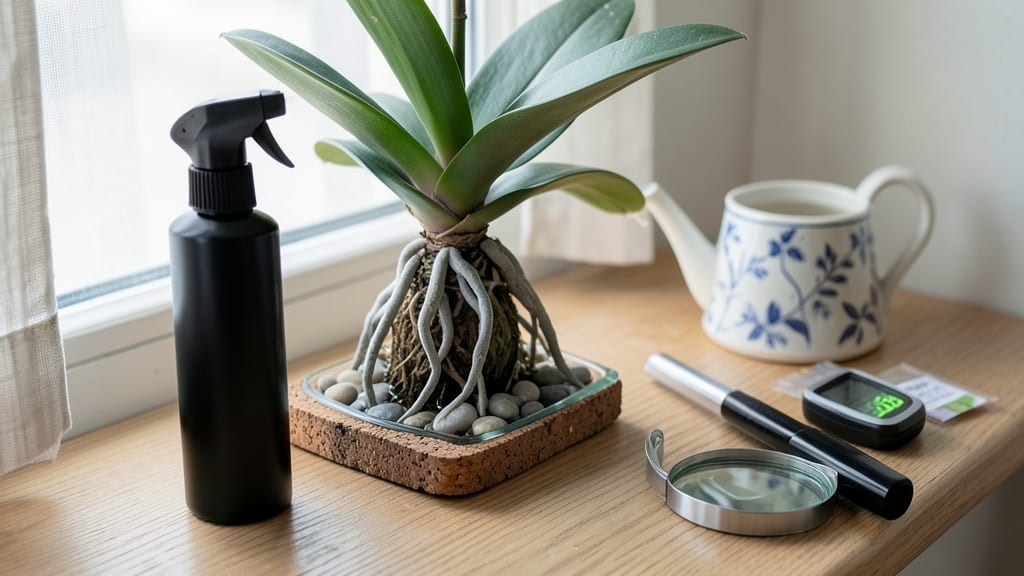
Watering mounted orchids 🌸 depends on how often their roots stay slightly damp—not soggy, not bone-dry—because the wrong schedule kills them faster than you’d think.
Picture this: You check your orchid one day, and the roots look healthy, but by next week, they’re shriveled or worse, rotting. The fix? A 10-minute root check that tells you exactly when to water, without guessing.
Most growers overcomplicate it, but the truth is simpler: humidity, season, and even your home’s airflow change how quickly roots dry out. I’ll show you how to adjust your watering routine in just a few minutes a week—no complicated tools needed.
By the end, you’ll know the exact signs your orchid is thirsty (or drowning) and how to tweak your schedule for summer’s heat or winter’s dry air. Let’s make your mounted orchid care effortless.
The 10-Minute root check: how to determine when mounted orchids need water
Mounted orchids rely on their roots to absorb moisture from the air, unlike potted plants. This means root health is your best indicator of hydration needs. A quick visual inspection—taking just 10 minutes—can prevent both underwatering and overwatering, the two biggest killers of mounted orchids.
Start by gently lifting your orchid to examine the roots without damaging them.
Healthy mounted orchid roots should be firm and plump, with a silver-green hue when dry and a greenish color when hydrated. If the roots feel shriveled or hollow, it’s a clear sign they need water.
Conversely, if they’re mushy or blackened, you’ve overwatered. This simple check eliminates guesswork and keeps your orchid thriving.
Here’s the key: texture matters more than color. Even if roots look green, pinch one gently—if it feels leathery or dry, it’s time to water. For best results, perform this check every 5-7 days during warm months and every 10-14 days in cooler weather.
Adjust based on your climate’s humidity levels and temperature fluctuations.
When checking roots, focus on the older roots first—they’re more sensitive to dehydration. If your orchid is mounted on cork bark, lift it slightly to inspect the underside where roots cluster.
For orchids on tree fern slabs, look for roots clinging to the edges. Pro tip: Use a magnifying glass if your orchid has tiny roots to spot early signs of stress.
Don’t rely solely on a watering schedule. Factors like indoor humidity (below 40% requires more frequent watering) and airflow (poor circulation speeds drying) drastically change needs.
For example, a mounted Phalaenopsis in a humid bathroom may need water every 5 days, while a Dendrobium in dry air might stretch to 10 days between waterings.
After watering, let your orchid dry completely before the next check. This prevents root rot, a silent killer. In high humidity, this might take 24-48 hours; in dry air, 6-12 hours suffices.
Use a spray bottle with room-temperature water for a gentle soak, or submerge the mount in water for 10-15 minutes if roots are severely dry.
Seasonal shifts demand adjustments. In summer, increase checks to every 3-5 days due to higher evaporation rates. In winter, reduce to every 2 weeks as growth slows.
Pay attention to leaf turgor—wilting leaves signal dehydration, while yellowing leaves often mean overwatering. Balance these cues with your root checks for foolproof care.
For beginners, start with a weekly root check to build familiarity. Over time, you’ll intuit when your orchid needs hydration based on root color shifts and environmental cues.
Remember: mounted orchids prefer thirst over drowning. With this method, you’ll keep roots happy, blooms abundant, and your orchid thriving for years.
🌱
Optimal watering frequency for mounted orchids by season and climate
Mounted orchids rely on their unique growing method—attached to bark or slotted containers—to absorb moisture and nutrients. Unlike potted orchids, they dry out faster because their roots are exposed to air. This means your watering schedule must adapt to seasonal shifts and local humidity, not just a one-size-fits-all approach.
For example, a Phalaenopsis in a humid Florida climate needs water every 5-7 days in summer, while a Cattleya in dry Arizona might only need water every 10-14 days in winter.
Climate plays a starring role in determining how often to water. In tropical climates (like Hawaii or Puerto Rico), high humidity means orchids lose moisture slowly—check roots weekly but water only when they feel dry.
In arid regions (such as deserts), orchids dry out quickly; you may need to water every 3-5 days in peak summer heat. Even indoor conditions matter: a mounted orchid near a humidifier stays moist longer than one in a dry office.
| Season | Climate Type | Orchid Type | Watering Frequency | Root Check |
|---|---|---|---|---|
| Spring | Tropical | Phalaenopsis | Every 7-10 days | Light green roots |
| Spring | Arid | Cattleya | Every 10-14 days | Slightly shriveled roots |
| Summer | Tropical | Vanda | Every 5-7 days | Darker green roots |
| Summer | Arid | Dendrobium | Every 3-5 days | Silvery-gray roots |
| Fall | Tropical | Oncidium | Every 7-10 days | Firm, pliable roots |
| Winter | Arid | Cymbidium | Every 14-21 days | Dry, papery roots |
Spring is a transitional season for mounted orchids. As temperatures rise, increase your watering frequency by 20-30% compared to winter. Start by watering every 7-10 days and adjust based on rainfall. If you notice wrinkled leaves or silvery roots, it’s time to hydrate.
For Phalaenopsis, which are popular for their lush blooms, aim to mimic their natural epiphytic habitat—water in the morning so excess moisture evaporates by evening. In humid climates, you might stretch this to 10-14 days.
Summer demands the most attention. High temperatures and low humidity cause mounted orchids to dry out rapidly. Water every 3-7 days, depending on your climate. A quick test: lift your orchid—if it feels lighter than usual, it’s thirsty.
For Vandas, which thrive in warm, humid conditions, consider misting roots lightly between waterings. In arid regions, water deeply but less frequently to encourage robust root growth. Avoid watering at night to prevent fungal issues.
Fall signals a slowdown in growth, so reduce watering to every 7-14 days. Monitor your orchid’s response: if new growth appears, maintain the current schedule. If leaves stay plump and vibrant, you’re on track.
For Cattleyas, which often bloom in fall, reduce water slightly to stress them into flowering. In tropical climates, where humidity remains high, you may only need to water every 10-14 days. Always prioritize root health over a strict schedule—adjust as needed.
Winter is the easiest season to manage. Most mounted orchids enter a dormant phase, requiring water every 2-3 weeks. Check roots before watering: if they’re dry and papery, it’s safe to hydrate.
For Dendrobiums, which often need a dry rest, water sparingly to mimic their natural winter conditions. In indoor settings, use a hygrometer to track humidity—keep it above 40% to prevent desiccation. Overwatering in winter is a common mistake; stick to the root check to avoid soggy roots.