
How To
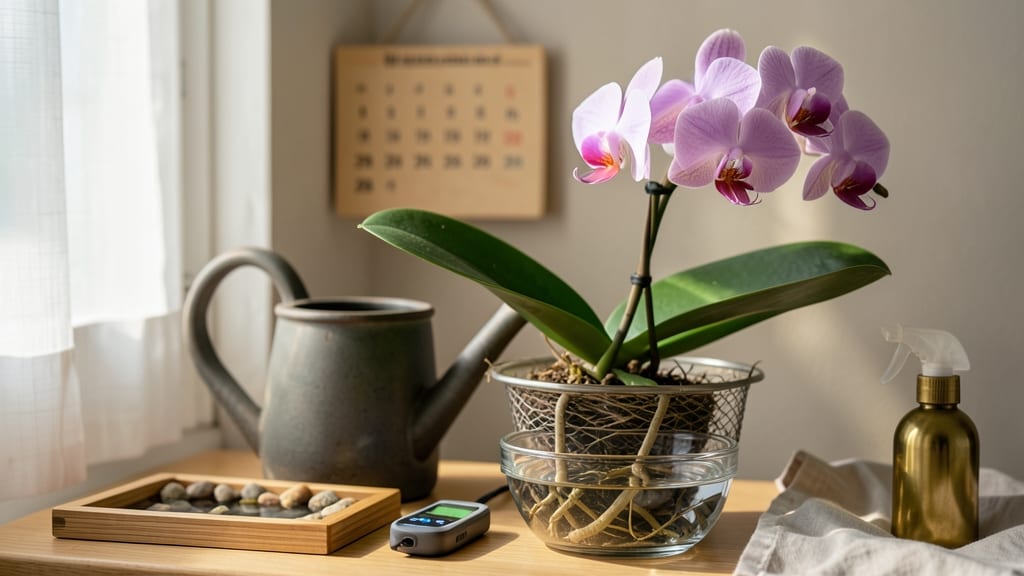
Watering orchids in a dry environment requires precision—most thrive when soaked every 5 to 7 days but can’t handle soggy roots, making the difference between lush blooms and silent death.
Picture this: your 🌸 orchid sits on the shelf, its leaves crisping at the edges while the pot stays bone-dry. You panic, drench it, and two weeks later, the roots turn to mush. That’s the tightrope orchids walk in low humidity—too much water drowns them, too little starves them.
The key isn’t just how often you water but how you do it: deep soaks, proper drainage, and reading the plant’s subtle signals.
Here’s the game-changer: orchids in dry climates like yours need a consistent routine, not guesswork. We’ll break down the exact schedule by season, the tools that save your plants from root rot, and how to spot the 5 signs you’re over- or under-watering before it’s too late.
By the end, you’ll water with confidence—no more wilting blooms or mystery spots on the leaves. Let’s turn your orchid care from stressful to effortless, even in the driest air.
Orchid watering schedule for dry environments: exact frequency by type and season
Orchids thrive in tropical conditions, but when humidity drops below 40%, their watering needs shift dramatically. In dry environments, the key is precision timing—not just frequency.
Unlike tropical natives, orchids in arid climates can't rely on ambient moisture, so their roots must absorb water efficiently while avoiding root rot. The solution? A seasonal schedule tailored to your orchid's type and your home's microclimate.
Most orchids signal thirst through wrinkled leaves or lightweight pseudobulbs, but these cues arrive too late in extreme dryness. Instead, I rely on a three-step system: checking substrate moisture, monitoring root color, and adjusting for temperature swings.
For example, my Phalaenopsis in a west-facing window gets watered every 5-7 days in summer, while my Cattleya—which loves warmth—needs water every 7-10 days during its winter dormancy.
Humidity levels under 40% change everything. At these thresholds, orchids lose moisture 30% faster than in standard conditions. That means your usual weekly watering might actually dehydrate your plants. The fix? Morning watering (before 10 AM) to prevent evaporation, and larger soakings—not frequent sips. I’ve found that terracotta pots help too, as they wick moisture from the air, while plastic traps humidity and risks rot.
🌱 Orchid Watering Schedule Comparison (Dry Environments)
| Orchid Type | Spring/Summer (Humidity 30-40%) | Fall/Winter (Humidity <30%) | Key Adjustments |
|---|---|---|---|
| Phalaenopsis (Moth Orchid) | Every 5-7 days | Every 7-10 days | Use lukewarm water; avoid wetting leaves |
| Cattleya (Cattle Orchid) | Every 7-10 days | Every 10-14 days (dormancy) | Reduce to every 3 weeks in winter |
| Dendrobium (Stem Orchid) | Every 3-5 days (active growth) | Every 14-21 days (dormant) | Soak only the roots; avoid stems |
| Oncidium (Dancing Lady) | Every 5-7 days | Every 7-10 days | Use high humidity tray in winter |
| Paphiopedilum (Lady Slipper) | Every 7-10 days | Every 10-14 days | Keep consistent moisture; avoid drying out |
*All schedules assume terracotta pots and bright indirect light. Adjust for plastic pots (retain moisture longer) or lower light (reduce frequency by 20%).
The substrate test is my secret weapon for dry-environment orchids. Stick your finger 1 inch deep into the mix—if it feels dry, it’s time to water. For bark-based mixes, this happens faster than in moss-heavy blends.
I’ve also switched to clear plastic pots for some varieties, which lets me see root color: silver/green roots mean they’re hydrated;
5 Signs your orchid is thirsty (or drowning) in dry conditions—and how to fix it
Dry environments confuse orchids—they mimic their tropical origins but with low humidity and fluctuating temperatures. Your plant may look fine one day and wilt the next, signaling a watering crisis.
The key is recognizing subtle stress signals before irreversible damage occurs. Unlike succulents, orchids can't store excess water, making their needs precise and urgent.
Overwatering is the silent killer in dry climates, where stagnant moisture breeds root rot faster than you'd expect. But underwatering causes its own havoc: wrinkled pseudobulbs and drooping leaves that never bounce back.
I’ve revived orchids from both extremes—here’s how to spot the warning signs and act before it’s too late.
- 1 Water every 7-10 days in dry indoor air (below 40% humidity). Test by inserting a wooden skewer into the mix—if it comes out dry, it’s time.
- 2 Morning watering only prevents fungal growth. Use room-temperature water and soak until it drains completely from the bottom.
- 3 Adjust for seasons: Reduce to every 10-14 days in winter dormancy (Phalaenopsis) or increase to every 5 days in summer heat (above 85°F).
- 4 Use clear pots to monitor root health. Healthy roots are green and firm; gray or mushy roots mean overwatering—repot immediately in fresh bark mix.
- 5 Boost humidity to 50-70% with a pebble tray or humidifier. Group orchids together to create a microclimate—this mimics their natural habitat and cuts watering needs by 30%.
Your orchid’s leaves are the first to scream for help. Look for yellowing edges or translucent patches—these mean underwatering. But if the entire leaf turns yellow and feels soft, you’ve got root rot from overwatering.
The fix? Trim dead roots with sterilized scissors and repot in fresh bark mix.
Don’t ignore wrinkled pseudobulbs—they’re like water storage tanks shrinking from thirst. Gently press a pseudobulb: if it springs back slowly, it’s dehydrated. Soak the pot for 10-15 minutes and let it dry completely before the next watering.
Pro tip: Phalaenopsis orchids can tolerate slight wrinkling better than Cattleyas, which need consistent moisture.
Mushy, black roots are a red flag for root rot, especially in plastic pots where water pools. Emergency action: Remove the orchid, rinse roots under running water, and trim away squishy sections with a sterilized knife.
Let the roots air-dry for 24 hours before repotting in coarse bark mix. Hold off on watering for 5-7 days to let wounds heal.
Reviving an orchid takes patience, but the payoff is lush, vibrant blooms that last for months. Start with these fixes, and your orchid will thrive even in the driest conditions. The secret? Observe daily—your plant’s subtle cues are its way of talking to you. 🌸