
Flowers
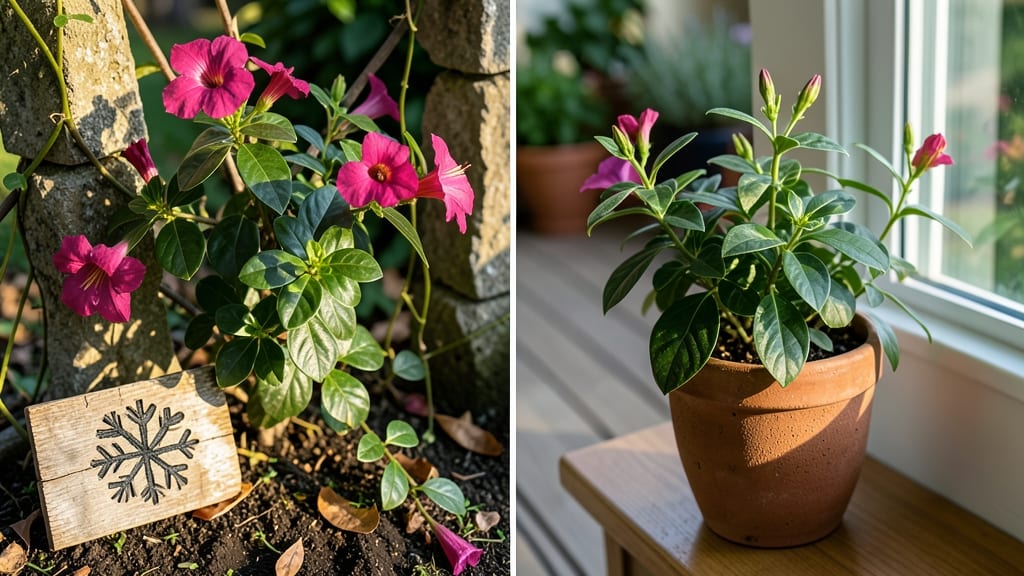
Mandevilla is a perennial only in frost-free climates like USDA zones 9-11, where it stays evergreen year-round. In colder regions, it behaves as an annual or tender perennial, dying back when temperatures drop below 30°F (-1°C).
This tropical beauty thrives as a true perennial because it evolved in warm climates without natural frost resistance. 🌿 In colder zones, gardeners often treat it like a seasonal plant, digging up tubers or container plants before winter.
The key difference lies in its biological adaptation—Mandevilla simply can't survive prolonged freezing, which is why even "cold-hardy" varieties need winter protection in zones below 9.
What makes this interesting is how gardeners in colder climates still enjoy Mandevilla year after year by using clever overwintering techniques. Many grow it in containers that can be moved indoors, or they protect outdoor plants with thick mulch and frost blankets.
This approach turns what would be a one-season plant into a long-term garden favorite with minimal extra effort.
💡 In This Article
- Mandevilla’s Cold Hardiness Zones Explained
- How to Overwinter Mandevilla in Cold Climates
Mandevilla’s cold hardiness zones explained
The Mandevilla plant's perennial status depends entirely on climate, specifically the USDA hardiness zones where it's grown. In zones 9-11, where winter temperatures rarely drop below 20°F (-7°C), Mandevilla thrives as a true evergreen perennial.
Its thick, leathery leaves and woody stems are naturally adapted to mild winters, allowing it to maintain foliage year-round without protection. 🌿 This is because its native habitat in South America's tropical regions never experiences freezing temperatures, so its biological systems lack frost tolerance mechanisms found in temperate perennials.
When temperatures fall below 30°F (-1°C), Mandevilla's cellular structure begins to break down. The plant's water content freezes and expands, rupturing cell walls in a process called cryodamage.
Most varieties can't recover from prolonged exposure to 28°F (-2°C) or lower, which is why gardeners in zones 8 and colder treat it as an annual or tender perennial.
Even the most cold-hardy Mandevilla cultivars, like 'Alice du Pont', typically survive only to 25°F (-4°C) with heavy mulching - a far cry from true hardiness.
The key difference between Mandevilla's behavior in warm vs. cold climates lies in its growth cycle. In frost-free zones, it grows continuously, producing vibrant blooms from spring through fall. In colder regions, it enters a dormant state when temperatures drop, with stems dying back to the ground.
What remains are the roots or tubers, which store energy for regrowth when warm weather returns. This survival strategy is similar to how dahlias or cannas behave in northern climates.
What most gardeners don't realize is that Mandevilla's cold sensitivity extends beyond just the leaves. The plant's vascular system (which transports water and nutrients) is particularly vulnerable to freezing. When temperatures drop, the water in these vessels crystallizes, blocking nutrient flow and causing irreversible damage.
This is why even brief cold snaps can kill established Mandevilla plants in marginal zones, despite their tropical appearance during growing season. 🥶
Interestingly, Mandevilla's cold tolerance varies slightly between varieties. While most commercial cultivars top out at 25-28°F (-4 to -2°C), some newer hybrids have shown improved hardiness up to 20°F (-7°C) with proper winter care.
However, these still pale in comparison to true perennials like boxwood or holly, which routinely survive -10°F (-23°C) or lower. The plant's tropical origins fundamentally limit its cold endurance.
Understanding these temperature thresholds helps explain why Mandevilla's perennial status is so climate-dependent. In warm coastal areas of California or Florida, it grows like a robust shrub with minimal care. But in the Midwest or Northeast, it requires annual digging or container culture to survive winter at all.
This geographical divide creates dramatically different growing strategies for the same plant species. 🌎