
Plants
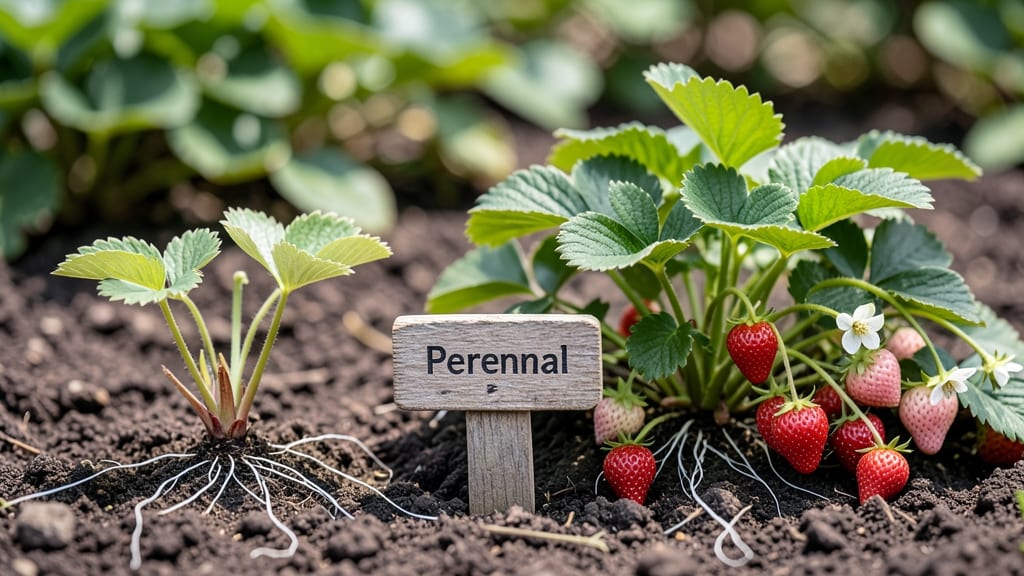
Strawberries in Zone 7 are perennial, but their crowns typically die back each winter due to cold temperatures, forcing regrowth from the roots in spring. With the right winter care, you can boost their survival and fruit production year after year.
Zone 7 winters can push strawberries into dormancy, where the above-ground parts freeze back while the roots stay alive underground. 🌱 This natural cycle means your plants aren't truly dying—they're just waiting for warmer weather to send up fresh shoots.
The key to keeping them productive is protecting those roots through mulching and insulation. I've found that varieties like 'Chandler' or 'Jewel' handle Zone 7 winters better than others, but even these benefit from a thick layer of straw or leaves come December.
What sets strawberries apart from other perennials is their ability to produce new crowns from the same root system each spring. That means with proper care, you're not starting from scratch—just giving your plants the best chance to bounce back stronger.
The first few weeks after winter are critical for monitoring regrowth, as weak shoots may need extra support to establish themselves.
💡 In This Article
- Why Strawberry Crowns Die Back in Zone 7 Winters
- How to Extend Strawberry Longevity in Zone 7 Gardens
Why strawberry crowns die back in Zone 7 winters
Strawberries are classified as hardy perennials, but their crowns—where leaves and flowers emerge—lack the same cold tolerance as their roots. In Zone 7, winter temperatures often dip below 10°F, which is the critical threshold where strawberry crowns begin to suffer irreversible damage.
The crown contains meristem cells responsible for new growth, and when exposed to prolonged freezing, these cells dehydrate and rupture, causing the plant to appear dead above ground. 🌡️ Unlike true perennials like asparagus or rhubarb, which have crowns that survive -20°F or lower, strawberries are more sensitive, with most varieties only tolerating down to 0°F without protection.
The roots, however, are a different story. Strawberry roots can survive much colder temperatures—often down to -10°F—because they contain higher concentrations of antifreeze proteins that prevent ice crystal formation in their cells.
This is why you’ll frequently see strawberry plants "die back" in winter only to regrow from the same root system in spring. The roots act as a biological bank, storing energy reserves in the form of starches that fuel the new crown growth once temperatures rise above 40°F.
This dormancy cycle is triggered by shorter daylight hours and cooler temperatures, a survival mechanism that conserves energy until conditions improve.
Comparing strawberries to other perennial fruits highlights their unique vulnerability. Blueberries, for example, have crowns that can withstand -15°F with proper mulching, while raspberries’ canes survive -20°F when buried in soil.
Strawberries’ crowns simply lack the protective adaptations of these hardier perennials. 🍓 The lack of thick bark or insulating layers means even a light frost can cause surface damage, while deeper freezes penetrate to the crown.
This is why Zone 7 gardeners often see their strawberry beds look completely lifeless in January, only to burst back to life by March—it’s not a failure, but a carefully timed biological reset.
What most people don’t realize is that the timing of this dieback matters just as much as the temperature. Strawberries enter dormancy gradually as nights grow shorter in late fall, but if an early cold snap hits before the plant has fully hardened off, the damage can be more severe.
This is why gardeners in Zone 7 should aim to mulch their strawberry beds by mid-October, before the first hard freeze. The mulch acts as an insulating blanket, slowly releasing its own heat while preventing rapid temperature swings that can shock the crowns.
Without this protection, the crowns become vulnerable to something called "freeze-thaw cycling," where repeated freezing and melting causes cellular damage.
Interestingly, strawberries have evolved this dieback strategy because it actually benefits their long-term survival. By shedding their above-ground biomass, the plant redirects energy to root development, creating a stronger foundation for next year’s growth.
This is why well-established strawberry patches often produce more vigorously after a winter dieback than newly planted ones.
The trade-off is that this process requires patience—it can take 4-6 weeks after the last frost for new shoots to emerge, and during this time, the roots are still vulnerable to secondary stresses like soil compaction or fungal infections from excess moisture. 🌱
The science behind this involves something called "cold acclimation," where plants gradually adjust their cellular chemistry to withstand freezing. Strawberries produce more sugars and proteins that act as natural antifreeze agents, but this process takes time.
If winter arrives abruptly (as it often does in Zone 7), the crowns may not be fully prepared.
This is why gardeners in areas with unpredictable winters should consider using row covers or low tunnels in late fall to extend the growing season and allow the plants more time to harden off naturally.