
Vegetables
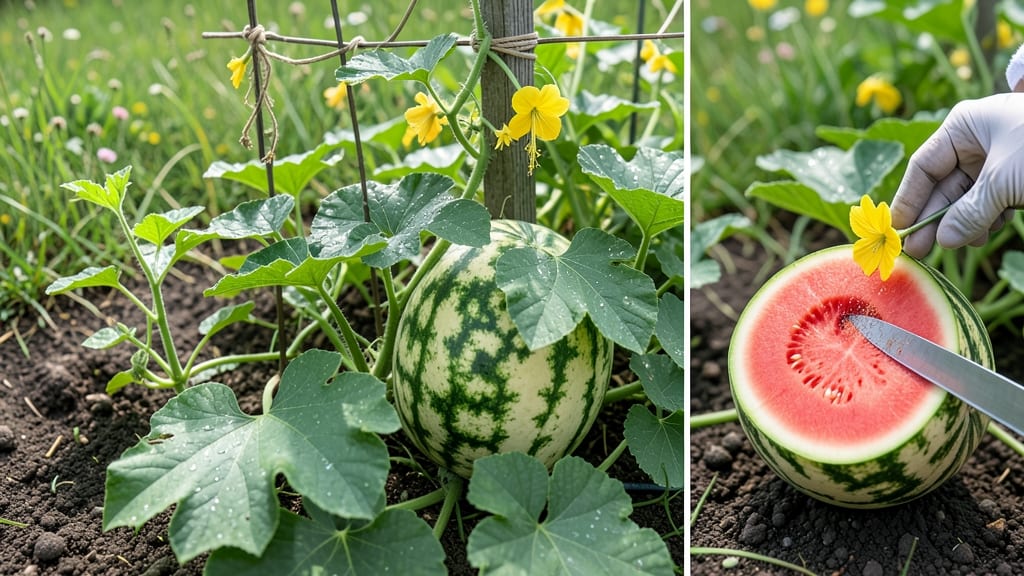
To grow seedless watermelons, you need controlled pollination of hybrid varieties where female flowers are cross-pollinated with pollen from seedless male plants, creating triploid fruit that produces sterile seeds. This method demands precise plant selection and ideal growing conditions.
Seedless watermelons rely on a clever genetic trick where the fruit develops from a cross between a female watermelon plant and a seedless male plant. 🌱 The resulting fruit has three sets of chromosomes (triploid), which prevents normal seed formation.
This process isn't natural—it requires farmers to carefully select compatible varieties and monitor pollination closely. Without this precise control, the fruit would either fail to develop or produce regular seeds.
What makes this fascinating is how the fruit's cells divide differently during development. The extra chromosome set disrupts the normal seed formation process, leaving you with that juicy, seed-free flesh we all love.
This same technique is used in other seedless fruits like grapes and citrus, proving how plant genetics can create convenient solutions for consumers.
💡 In This Article
- The Science Behind Seedless Watermelon Hybridization
- Step-by-Step Guide to Growing Seedless Watermelons at Home
The science behind seedless watermelon hybridization
The magic of seedless watermelons begins with a genetic phenomenon called triploidy. Normal watermelons have two sets of chromosomes (diploid), but seedless varieties are created by crossing a female watermelon plant (diploid) with a seedless male plant (tetraploid, with four sets of chromosomes).
This produces fruit with three sets of chromosomes (triploid), which disrupts normal seed development. The extra chromosome set prevents the ovules from maturing into viable seeds, leaving you with that prized seedless flesh.
The key to success lies in the pollen donor. Seedless male plants are specially bred to produce pollen that, when transferred to female flowers, creates the triploid condition. These male plants are often sterile themselves—they can't produce fruit but excel at donating pollen.
Farmers must carefully select varieties where the female plant's flowers are receptive to the male's pollen, typically requiring hand pollination or strategic planting to ensure cross-pollination occurs. Without this precision, the fruit may develop normally with seeds or fail to set at all.
What happens at the cellular level is equally fascinating. In normal watermelon seeds, the fertilized ovule undergoes meiosis, dividing to produce four haploid cells that develop into seeds. But in triploid fruit, the extra chromosome set disrupts this process.
The cells can't properly divide, leaving behind sterile ovules that never mature. This same principle applies to other seedless fruits like seedless grapes or navel oranges, where controlled hybridization creates consumer-friendly varieties. 💫
Environmental factors play a crucial role in this process. Seedless watermelons thrive in warm climates (70-90°F) with long daylight hours (12+ hours), as these conditions optimize flower development and pollination. The plants also require well-draining soil with a pH of 6.0-6.8 to support vigorous growth.
Without these ideal conditions, the female flowers may not produce enough pollen-receptive stigmas, or the resulting fruit might develop poorly, leading to smaller or less flavorful melons.
One common misconception is that seedless watermelons are a natural mutation. In reality, they're the result of decades of plant breeding and genetic research. Early seedless varieties emerged in the 1930s, but modern seedless watermelons are the product of precise crossbreeding programs that balance sweetness, size, and yield.
The best commercial varieties today, like 'Triple Crown' or 'Sugar Baby,' are the result of selecting for traits that make them both seedless and delicious—proof that science can deliver on convenience without sacrificing quality.
For home gardeners, this means choosing certified seedless varieties and understanding that you'll need to plant both male and female plants (or use pollen from a seedless male) to achieve the triploid effect.
The payoff? Watermelons that are 90% seedless by volume, with flesh that's consistently sweet and uniform—no digging through seeds to enjoy the good stuff. 🍉