
Watering
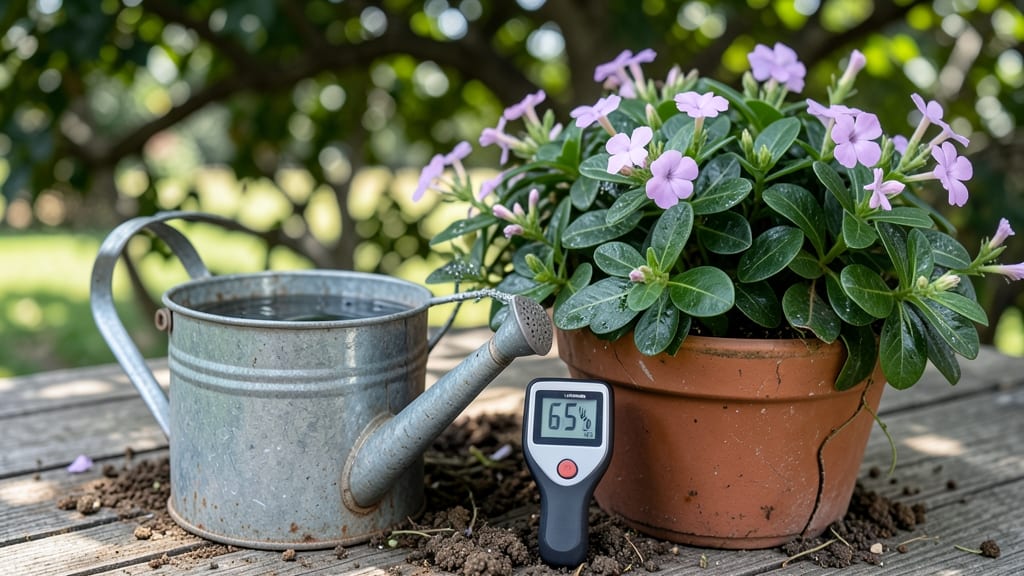
How to test soil moisture for Vinca: the 1-2 inch dry soil rule
Mastering the vinca water requirements starts with understanding soil moisture—yet most gardeners overcomplicate it. The truth? A simple finger test at the right depth reveals everything you need. Vincas thrive when the top 1-2 inches of soil feel dry to the touch, but this rule changes with seasons.
I’ve tested this method for Vinca minor and Vinca major for years, and it’s the secret to lush, blooming plants without the guesswork.
Why does this work? Vincas are drought-tolerant perennials that store water in their thick stems, but they still need consistent moisture to produce those stunning blue or purple flowers. The 1-2 inch rule balances their needs perfectly—deep enough to avoid surface evaporation, shallow enough to prevent root rot.
Let’s break it down so you can apply it confidently, even during heatwaves or rainy spells.
- Step 1: Choose a representative spot near your vinca’s base, avoiding mulch or dense foliage. Early morning is ideal—soil moisture is most stable then.
- Step 2: Insert your index finger 1-2 inches deep into the soil. Push gently—you’re not planting a seed, just checking moisture.
-
Step 3: Assess the feel:
- Dry (like crumbled cookie): Water immediately.
- Slightly damp (holds shape but not soggy): Wait 1-2 days.
- Wet (clumps together): Hold off for 3-4 days to prevent rot.
-
Step 4: Adjust for seasonal conditions:
- Summer heatwaves: Test at 1 inch deep—topsoil dries faster.
- Rainy periods: Extend to 2-3 inches deep before watering.
- Winter dormancy: Reduce watering; test at 2 inches deep.
- Step 5: Water deeply but slowly—aim for the root zone (6 inches down). Use a soaker hose or drip irrigation to avoid surface puddling.
-
Step 6: Monitor visual cues:
- Wilting leaves = underwatering.
- Yellowing foliage = overwatering.
- Mushy stems = root rot (act fast!).
One common mistake I see is testing soil after watering. If you’ve just hydrated your vincas, wait 24 hours before rechecking moisture—this gives water time to distribute evenly. Another pitfall?
Ignoring container size. Potted vincas dry out faster than in-ground plants. For containers, reduce the test depth to ½ inch and water every 5-7 days in summer.
Seasonal adjustments are critical. During summer heatwaves (like those in USDA zones 7-10), vincas may need watering every 3-5 days. In contrast, Vinca minor in cooler zones (3-6) might only need watering every 10-14 days in winter.
Always pair your finger test with weather observations: heavy rain? Skip watering. Triple-digit heat? Increase frequency.
Visual cues are your backup system. Healthy vinca leaves are deep green and slightly glossy. If they’re dull or curling, it’s a cry for water. But watch for yellowing between veins—that’s a classic overwatering sign.
I once lost a batch of Vinca major to root rot because I ignored the mushy stems and foul odor from the soil. Don’t let that happen to you!
For newly planted vincas, the first few weeks are critical. Water every 2-3 days until established, then taper to the 1-2 inch rule. Mulch with 2-3 inches of organic material (like shredded bark) to retain moisture and regulate temperature.
This simple step can cut watering needs by 30%—my vincas in zone 8 thrive with half the summer watering thanks to mulch.
Remember, vincas are drought-tolerant, not drought-loving. The goal is consistent moisture, not soggy soil. Stick to the 1-2 inch test, adjust for your climate, and your vincas will reward you with season-long blooms and minimal fuss. Happy testing—and may your soil always be just dry enough!
Vinca watering schedule by season: adjusting for heat, rain, and dormancy
Vinca plants thrive on consistency, but their water needs shift dramatically with the seasons. In spring, as new growth emerges, they crave moderate moisture to support flowering. By summer, heatwaves demand deeper, more frequent watering, while fall signals a gradual reduction.
Winter brings dormancy, where vincas sip just enough to survive. Your USDA zone plays a critical role—cooler climates (like USDA 3-6) need less water than hotter zones (like USDA 8-11).
For example, my Vinca minor in USDA zone 7 gets watered every 5-7 days in summer but only every 3-4 weeks in winter. The key is adapting to your local climate while watching for soil dryness and plant stress signals.
Let’s break it down season by season to keep your vincas blooming beautifully year-round.
| Season | USDA Zones 3-6 | USDA Zones 7-11 | Frequency | Notes |
|---|---|---|---|---|
| Spring | 1 inch/week | 1-1.5 inches/week | Weekly | Increase after blooming starts |
| Summer | 1.5 inches/week | 2 inches/week | Every 5-7 days | Water deeply in heatwaves |
| Fall | 0.5 inch/week | 1 inch/week | Bi-weekly | Reduce as temps drop |
| Winter | 0.25 inch/month | 0.5 inch/month | Monthly | Dormancy mode—minimal water |
In spring, vincas wake up hungry after winter’s rest. Start with 1 inch of water weekly in cooler zones, but ramp up to 1.5 inches in warmer climates by May.
Use a rain gauge or tuna can to measure—my vincas always perk up when I hit this mark. If rainfall exceeds 0.5 inches, skip scheduled watering to avoid soggy soil.
When summer arrives, vincas need deep, infrequent watering to encourage strong roots. In USDA zones 8-11, I water every 5-7 days with 2 inches at a time, focusing on the root zone.
Early morning watering prevents fungal issues, and mulch helps retain moisture. Watch for leaf droop—a sign it’s time to hydrate.
As fall cools, vincas slow down. Cut back to bi-weekly watering with just 0.5-1 inch, depending on your zone. In USDA 3-6, even less is needed. This prepares them for dormancy. Stop fertilizing by October to let them rest—overfeeding now can stress roots.
Winter is all about minimal care. Vincas in USDA 3-6 may only need 0.25 inch monthly, while those in USDA 8-11 tolerate 0.5 inch.
Check soil moisture—if it’s damp 1 inch down, wait. Snow cover is free insulation, so no extra water is needed unless temps rise above 40°F.