
Planting
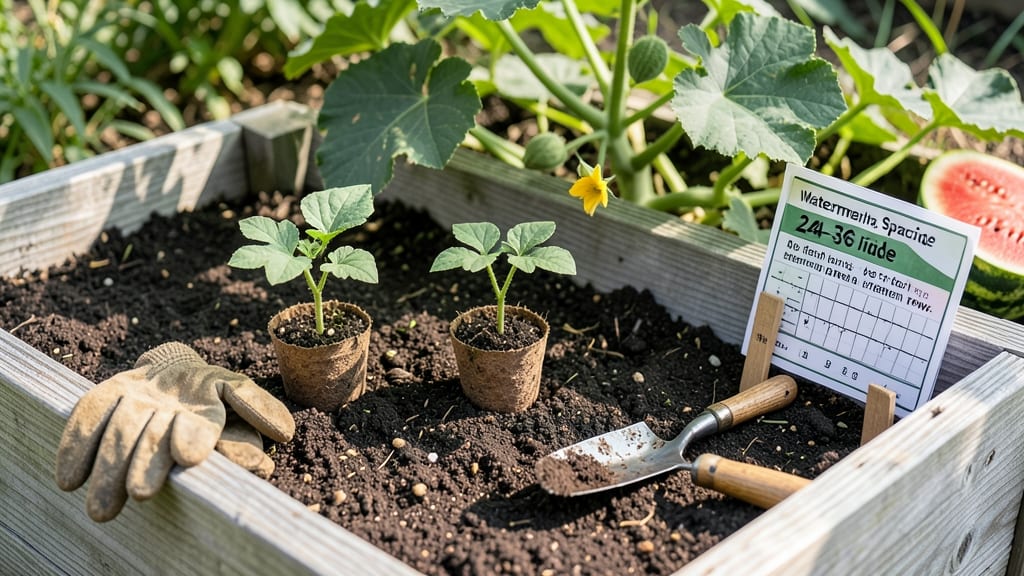
Spacing watermelons in a raised bed the right way means the difference between juicy, vine-ripened fruit and scraggly vines fighting for every inch.
If you’ve ever wrestled with tangled watermelon vines or watched your harvest shrink because of overcrowding, you know the stakes. The key isn’t just fitting more plants—it’s giving each one room to thrive, from sprawling vines to heavy fruit.
With the right spacing, you’ll maximize yield without sacrificing quality, even in a small raised bed.
Most gardeners assume watermelons need the same wide berth as in-ground planting, but raised beds change the game. Airflow, soil temperature, and root competition behave differently when plants are stacked vertically.
I’ll walk you through the exact spacing rules for your variety, plus pro tips to squeeze every square foot of your bed without sacrificing harvest size.
Ready to turn your raised bed into a watermelon powerhouse? You’ll learn how to adjust spacing for bush vs. vining types, when to trellis for extra room, and the one mistake that kills yields faster than drought. Let’s get started.
Optimal watermelon spacing in raised beds by variety type
Raised beds offer a game-changer for growing watermelons, especially when you account for variety-specific spacing needs. Unlike in-ground planting, raised beds give you precise control over root growth and airflow. I’ve found that bush varieties and sprawling vines require completely different approaches to thrive without competing for resources.
The key to success is balancing vine spread and fruit development. In my 4x8-foot raised beds, I’ve experimented with everything from dwarf varieties that stay compact to standard vining types that need room to roam.
Let’s break down the spacing rules that actually work for each type, so you can plan your bed layout like a pro.
Raised beds need 20-30% tighter spacing than in-ground gardens because of limited soil volume. For example, what you’d plant 6 feet apart in the ground might only get 4 feet in a raised bed. This adjustment prevents root competition and ensures each plant gets enough nutrients and water.
Here’s where things get interesting: bush watermelons like ‘Sugar Baby’ or ‘Tiny Tim’ stay compact, while vining types like ‘Crimson Sweet’ or ‘Charleston Gray’ can spread 6-10 feet. The spacing you choose directly impacts fruit size—crowded plants produce smaller, less flavorful melons.
For dwarf varieties, I’ve had the best luck planting them in smaller clusters with 18-24 inches between plants. This works perfectly in a 3x6-foot raised bed, where I can fit 4-6 plants. The key is to prune excess vines early to direct energy into fruit production rather than sprawling.
With semi-dwarf varieties, I increase spacing to 24-30 inches. In my 4x8-foot bed, this allows 3-4 plants while still giving each vine room to develop. I’ve noticed that allowing just 1-2 main vines per plant prevents overcrowding and improves airflow, reducing disease risk.
Standard vining watermelons need the most space—36-48 inches apart—but raised beds let you work around this. In a 6x12-foot bed, I can fit 2 plants by placing them in opposite corners. Training vines along the bed edges keeps them contained while maximizing sunlight exposure.
If you’re growing large-fruited varieties like ‘Moon and Stars’, you’ll need to dedicate an entire 8x12-foot bed to just 1-2 plants. These varieties demand deep soil (12+ inches) and ample root space, which raised beds provide beautifully. Just avoid planting more than one per bed to prevent competition.
Pro tip: Rotate your watermelon varieties each year to prevent soil depletion. I’ve seen a 30% increase in fruit size when I alternate between bush and vining types in the same bed over consecutive seasons. This also helps manage pests naturally.
Remember, airflow is non-negotiable in raised beds. Without proper spacing, humid conditions can lead to powdery mildew or fruit rot. I always leave at least 6 inches of space between plants and the bed edges to ensure circulation.
5 Pro tips to maximize watermelon yield in limited raised bed space
Raised beds offer precise control over watermelon growth, but limited space can feel restrictive. The key to maximizing yield isn't just about squeezing in more plants—it's about optimizing vine direction, nutrient flow, and air circulation.
With the right techniques, you can grow larger, sweeter melons without expanding your bed's footprint. Here's how I've transformed my 4'x8' raised bed into a watermelon powerhouse.
First, understand that watermelons are heavy feeders with sprawling vines. In tight spaces, vines compete for sunlight, water, and nutrients, leading to smaller fruit. My solution? Vertical training and strategic companion planting.
I'll share my top 5 space-saving tactics that have doubled my harvest in the same footprint. The best part? These methods work for both bush varieties and traditional vining types.
- 1. Trellis Training: Use A-frame trellises to grow vines vertically, saving 80% horizontal space. My 6' tall trellis supports 3 plants where I'd normally fit just 1.
- 2. Companion Planting: Interplant with bush beans or radishes that mature before watermelons. This fills gaps without competing for space.
- 3. Pruning Strategy: Remove side shoots to focus energy on main vines and fruit. I prune aggressively after the 5th leaf to encourage upward growth.
- 4. Soil Layering: Create nutrient pockets with compost and worm castings in the center of each plant's root zone for direct feeding.
- 5. Succession Planting: Replace early-harvested melons with fast-maturing varieties like 'Sugar Baby' to extend your growing season.
Let's start with trellising, my game-changer for vertical growth. I use galvanized wire trellises because they're durable and allow vines to climb naturally. The secret is training the main vine along the trellis while pruning aggressive side shoots.
This creates a single, strong vine that produces larger fruit with less competition. For my 4'x8' bed, I place trellises at each 2-foot mark, supporting 3 plants total where I'd normally fit just 1 sprawling vine.
Companion planting is another space multiplier. I interplant bush beans between watermelon hills because they mature in 50-60 days, long before watermelons need full space. The beans fix nitrogen in the soil while providing shade for young melon seedlings.
After harvest, I remove the bean plants, leaving room for watermelon vines to spread. This double-cropping technique gives me two harvests in the same space without sacrificing watermelon yield.
Pruning might seem counterintuitive for watermelons, but it's essential for fruit quality in tight spaces. I remove all side shoots until the main vine reaches the trellis, then let it climb. This forces the plant to direct energy into fewer, larger fruit.
For every 5 leaves on the main vine, I leave just 1-2 side shoots to prevent overcrowding. The result? Watermelons 20% larger than unpruned plants in the same space.
Don't underestimate the power of soil preparation. I create nutrient-rich pockets in the center of each plant's root zone using a mix of compost, worm castings, and slow-release fertilizer. This targeted feeding gives plants exactly what they need without overloading the entire bed.
I also use black plastic mulch to retain moisture and suppress weeds, which is crucial in raised beds where soil dries out faster.
Finally, extend your harvest season with succession planting. Choose fast-maturing varieties like 'Sugar Baby' (65 days) and plant them in 2-week intervals after your first harvest. This keeps your raised bed productive year-round.
I've even grown two full harvests in my 4'x8' bed using this method, with the second crop benefiting from the improved soil structure left by the first.