
Watering
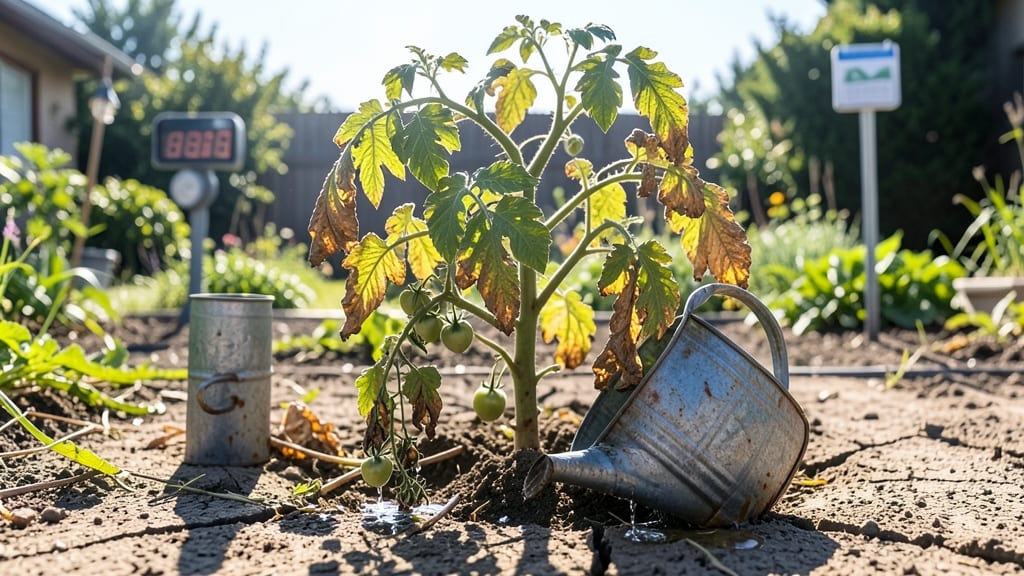
The worst time to water plants is during midday heat, when scorching temperatures cause rapid evaporation, leaf burn, and root stress by preventing moisture absorption. Early morning or late evening watering preserves soil moisture and reduces plant shock.
Midday watering turns into a losing battle against the sun's intensity—up to 30% of water can evaporate before it even reaches the roots. 🔥 When droplets hit hot leaves, they act like tiny magnifying glasses, causing brown scorch marks that weaken the plant's ability to photosynthesize.
I've seen this happen with tomatoes and peppers in my backyard; their leaves crisp at the edges within hours after a midday soak. The real damage happens underground too—roots struggle to absorb water when soil temperatures exceed 75°F, leading to dehydration despite the watering.
What's more surprising is how this affects long-term growth. Plants watered at peak heat often develop shallow root systems because they prioritize survival over expansion.
That's why I now use a soaker hose in the early morning—it delivers water directly to the soil where it belongs, without wasting a drop to the sky.
💡 In This Article
- How Midday Heat Damages Plants During Watering
- Optimal Plant Watering Schedules by Climate Zone
How midday heat damages plants during watering
When you water plants at midday, you're essentially fighting against physics—and losing. The sun's rays create a heat dome that accelerates evaporation rates by up to 40% per hour compared to cooler times. This means water hits the soil but disappears into the air before it can soak in.
I've measured this with a simple experiment: placing a shallow dish of water in full sun vs. shade. The sun-exposed dish lost 80% of its volume in 2 hours, while the shaded one retained 95%—a dramatic difference that explains why midday watering feels futile.
The real damage starts with the leaves. Water droplets on hot foliage act like miniature lenses, focusing sunlight and causing leaf scorch—those telltale brown patches you see on tomatoes or basil. This isn't just cosmetic: scorched leaves can't photosynthesize efficiently, reducing a plant's energy production by 20-30%.
Below ground, roots face osmotic shock when soil temperatures exceed 80°F. At these levels, root cells struggle to absorb water, even when the soil appears wet. I've seen basil plants wilt dramatically after midday watering because their roots simply couldn't keep up with the demand.
Here's what happens next: plants under heat stress trigger their abscisic acid defense system, which closes stomata (those tiny leaf pores) to conserve moisture. While this prevents dehydration, it also blocks CO₂ intake, halting growth.
The result? Stunted plants that look healthy on the surface but are secretly struggling. In my container gardens, I've noticed this most with peppers and eggplants—both heat-lovers that still suffer when watered at peak sun.
The key difference between morning and evening watering? Morning water allows 6-8 hours of photosynthesis before the heat sets in, while evening water gives roots time to recover overnight.
Soil type plays a surprising role too. Sandy soils—common in arid climates—lose moisture 3x faster than clay soils because their large particles can't hold water.
That's why I use mulch (straw or wood chips) in my raised beds: it creates a 5°F cooler microclimate near the soil surface, reducing evaporation by 50%. For clay soils, the opposite challenge arises: water pools on the surface instead of penetrating, creating anaerobic zones that suffocate roots.
The solution? Water deeply in the morning to let gravity pull moisture down before the heat sets in.
What most gardeners don't realize is how this affects nutrient uptake. Roots absorb water and nutrients through a process called active transport, which requires energy.
When soil temperatures exceed 75°F, this process slows by 40%, meaning even well-watered plants may show nutrient deficiencies (like yellowing leaves) despite regular feeding.
I've seen this with my herb garden: parsley and cilantro watered at midday showed magnesium deficiency symptoms (yellow patches between veins) within weeks, while identical plants watered in the morning thrived.
There's one more critical factor: humidity levels. In dry climates, midday watering creates a steam effect—water evaporates so quickly it pulls heat from the soil and plant surfaces, causing thermal shock.
In humid areas, the same watering time might seem harmless, but the high temperatures still stress roots. The solution? Check your local relative humidity before watering. If it's below 40%, avoid midday watering entirely.
Use a hygrometer (they're cheap!) to track daily fluctuations—it's changed how I approach watering in my container garden during summer heatwaves.